
One woman's inspirational tale about expressing joy amid
loss and suffering.
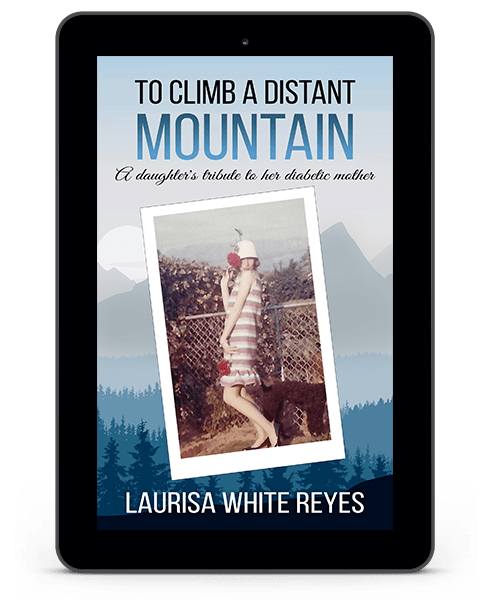
To Climb a Distant
Mountain:
A Daughter’s Tribute to Her Diabetic Mother
by Laurisa White Reyes
Genre: Historical True Memoir

In 1974, at the age of twenty-six, Cynthia Ball White was
diagnosed with Juvenile Diabetes. Today, it is estimated that 1.25 million
Americans suffer from what is now referred to as Type I diabetes, compared to
38 million who have Type 2 (adult onset) diabetes. It is a merciless disease
that often leads to blindness, neuropathy, amputations, and a host of other
ailments, including a shortened life span.
Despite battling diabetes for forty-five years, Cyndi beat
the odds. Not only did she outlive the average Type I diabetic, but until her
last week of life in 2021, she had all her “parts intact”. Her daughter often
called her a walking miracle. But more impressive was Cyndi’s positive outlook
on life, even in the midst of tremendous loss and suffering.
The author hopes that in sharing Cyndi’s story, others may
be inspired to face their own struggles with the same faith, courage, and joy
as her mother did.
Amazon
* B&N
* Bookbub
* Goodreads

Growing up watching
my mom suffer from neuropathy, glaucoma (damage to the eyes), and occasional
insulin reactions and hospitalizations took its toll on me. Concern for my
mother’s life was my constant companion.
One day, after I had walked the two miles home from school, I
entered my unusually quiet house. Normally at that time, I’d come home to find
Mom bustling about, but not today. I called for her but received no response.
Finally, I stepped into her bedroom. The drapes were drawn, and the room was
dark as night. Mom lay on her bed on her stomach, face turned against her pillow,
an arm drooping over the side of the bed. For a moment, a spasm of fear shot
through me. Was Mom dead? I stood frozen in place for what felt an eternity,
though it was mere seconds before Mom stirred, waking from her nap. She noticed
me, smiled, and asked how school was. I never told her what I’d
thought, or how deeply that flash of fear traumatized me.
I remember one
evening when we were all sitting around the dining table for dinner. The mood
was lighthearted, relaxed, and we were all just gabbing about things and
sharing jokes. My dad had a good one: “What do you find up an elephant’s trunk?”
He paused, then answered, “An eight-foot booger!”
We all laughed,
including Mom. But as most of our laughter died down, Mom’s didn’t. She kept on
laughing. In fact, she couldn’t stop. Seeing her so consumed by laughter was
funnier than the joke, and the rest of us continued laughing—at her. Mom was
laughing so hard that tears fell down her cheeks. Then Dad realized what was
happening.
Diabetics, when
their glucose levels drop dangerously low, are often mistaken for being drunk.
Some act belligerently, as depicted by Julia Roberts in the film Steel
Magnolias. Others become “tipsy”, slurring their speech or becoming
unbalanced. Still others are the “friendly” drunks, overly cheerful and
humorous.
Another sign of a
diabetic reaction is when the patient slows down. Long ago, there was a popular
TV commercial with the Energizer Bunny. As its batteries died, the toy moved
slower and slower until it finally stopped. Like a wind-up clock losing time, or
that bunny decelerating, that’s what it was like for Mom as her glucose levels
dropped, and that’s how Dad knew Mom was in danger. Mom could not control her
laughter, and then her batteries started to die.
Dad did not even
stop to test her blood. He ran for the kitchen and hurriedly poured a glass of
orange juice, a constant staple in our house, then coaxed Mom to drink it. It
wasn’t easy. She couldn’t focus on what needed to be done, to open her lips and
swallow—all between ever-weakening guffaws. If Dad had hesitated even one more
minute, she would have lost consciousness, been unable to drink the juice, and
would have needed an ambulance. We knew. We’d seen it happen before.
Fortunately, Dad saved the day—like he always did and always would. My dad is a
real-life Superman.
As a family, we
continued to retell that incident for decades. Repeating Dad’s joke always
elicited chuckles from us all, including Mom, but in reality, it was one of
many, many too close for comfort moments in our lives.

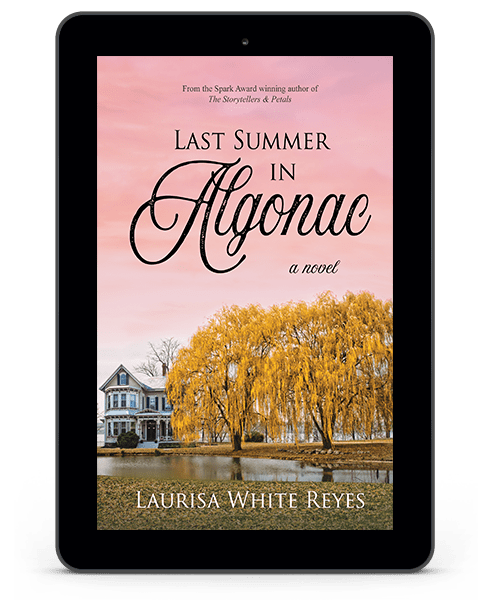
Last Summer in
Algonac
by Laurisa White Reyes
Genre: Fictionalized Family Biography
From the Spark
Award-winning author of The Storytellers & Petals...
The summer of 1938 is idyllic for fourteen-year-old Dorothy
Ann Reid. She’s spent every summer of her life visiting her grandparent’s home
on the banks of the St. Clair River in Algonac, Michigan. But unbeknownst to
her, this will be her last. As Dorothy and her family pass their time swimming,
fishing, and boating, they are blissfully unaware that tragedy lurks just
around the corner.
Last Summer in Algonac is a fictionalized account of the author’s grandmother
and her family’s final summer before her father’s suicide, which altered their
lives forever. Inspired by real people and events, Laurisa Reyes has woven
threads of truth with imagination, creating a “what if” tale. No one living
today knows the details leading to Bertram Reid’s death, but thanks to decades
of letters, personal interviews, historical research, and a visit to Algonac,
Reyes attempts to resolve unanswered questions, and provide solace and closure
to the Reid family at last.
Amazon
* B&N
* Bookbub
* Goodreads
We all noticed
the silver Cadillac when it first turned onto our street. Sleek and shiny as a
brand new silver dollar. But when it parked in front of the house, even the men
laid down their hands to look.
The driver’s
side door opened, and out stepped a short, squat woman with hair all white,
curled and set to perfection. She wore round silver spectacles on her nose and
a lilac dress. She shut the car door with a confident slam and perched her
fists on her hips, taking in several deep breaths.
“Well, I’m here now,” she said with a self-assured grin.
“Which one of you fellers gonna fetch my luggage from the trunk?”
I felt Mother
stiffen beside me and noted her fingers tighten around her lemonade. There was
a distinctive moment of hesitation before she set down her glass on the stand
beside her and stood, smoothing down her dress.
“Mother,” she said, giving Father ‘the look’ before heading
down the steps to greet our unexpected visitor.
Father elbowed
Charles, who then leapt up from his chair and bounded off the porch to the car.
“Hello
Grandma,” he said, planting a kiss on the older woman’s cheek.
Father took his
time leaving the table, but also made his way to the car and kissed his
mother-in-law.
Clara was born
in 1864 in Henrietta, Ohio. Christened Clara Petronella Peabody, a name I’ve
always been fond of, she was the seventh of thirteen children. “Smack dab in
the middle,” I’d heard her say. She’d married her first of three husbands,
Charles Noble, in 1882 and had three children, of whom Mother was the youngest.
Her third husband’s name was Pratt, so even though they weren’t together
anymore, we often called her Grandma Pratt.
In my favorite photo of her, taken later in the 1940s, she
posed alongside her favorite dog and wore a full-length fur coat. She looked
absolutely regal.
“Is that my little Dottie?” said Clara, coming up the porch
steps. I flew into her outstretched arms and allowed her to swallow me in a
tight embrace. She kissed the top of my head, then held me out from her by my
shoulders.
“All grown up, I see,” she said happily. “Sprouted a good
foot or two since I last seen you.”
“Grandma, I just saw you at Christmas!”
“I know it. I know it, but you look so darn tall these days,
and ladylike. What have you been feeding this child, Dorothy May?”
Mother forced a
smile. “She eats the same as everyone else,” she said. Charles
lugged Clara’s two carpet bags into the house.
“I take it you’re planning on staying here with us?” asked
Mother.
“Just give me the sofa,” said Clara. “I’m only staying for a
few days. I just come from your sister Leila Grace’s in Mount Pleasant. Stayed
on a few weeks there. And I promised to spend the 4th with your brother’s widow, Lillian. Now that
Frederick Jr. has gotten married, she’s all alone in that big old house of
hers. Might as well we two ladies spend some time together.”
Clara spotted
the card table and the two men sitting at it.
“John. Harry. Nice to see you both.”
“You two, Clara,” they both drawled.
“What are you playing?”
“Five Card Draw,” said John.
There was an
uncomfortable silence as Clara regarded each man through narrowed eyes. “Got
room for one more?” she asked.
John and Harry
looked at each other, then shrugged and scooted their chairs closer together.
“Charles!” Clara called into the house. “Bring out another
chair, and one of them cold glasses of lemonade.”



Laurisa White Reyes is
the author of twenty-one books, including the SCBWI Spark Award-winning
novel The Storytellers and the Spark Honor recipient Petals.
She is also the Senior Editor at Skyrocket Press and an English instructor at
College of the Canyons in Southern California. Her next release, a non-fiction
book on the Old Testament, will be released in August 2026 with Cedar Fort
Publishing.



I enjoyed the excerpt. Sounds like an interesting story.
ReplyDelete